Book Notes: Anthony Frewin on 1930s 'Astounding' Magazine Covers
Featuring artists Hans Wessolowski, Howard V Brown, Hubert Rogers, and other Astounding magazine illustrators.

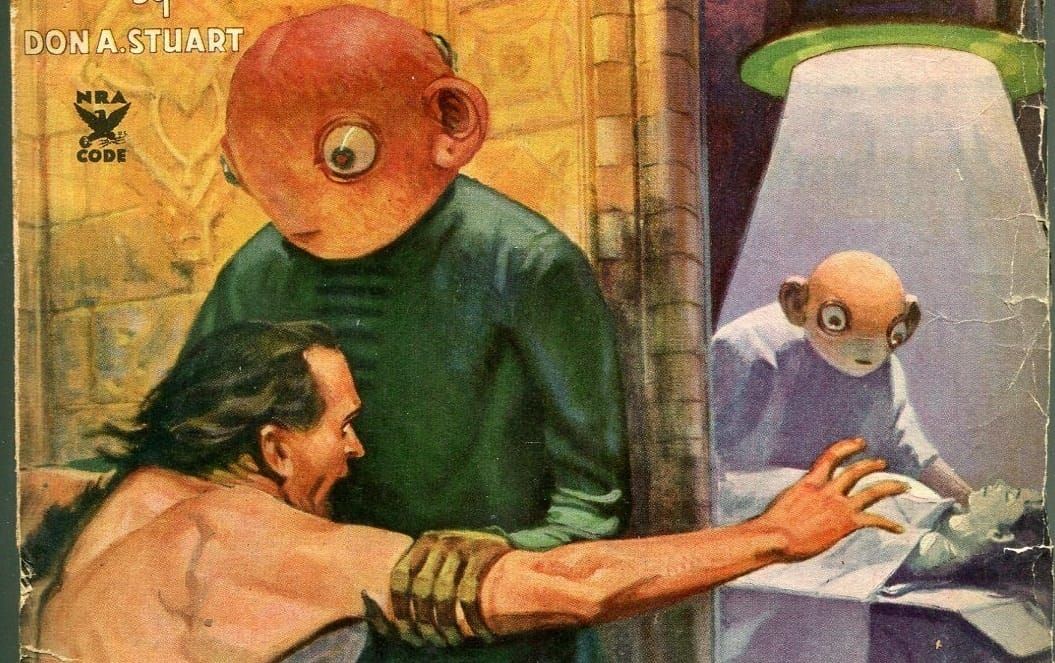
These are my notes and quotes from chapter five of One Hundred Years of Science Fiction Illustration, by Anthony Frewin, originally published in 1974.
This is a part two, following my notes on the first four chapters for paying subscribers.
Astounding Stories of Super-Science debuted in January 1930. Frewin sets the stage:
Page 73: "American pulp publishing in the 1920s and 1930s was a jungle of incest with the rival chains feeding on each other’s success and failure. The newsagents’ stands were aglow with the screaming logos and punchy artwork of periodicals like Fight Stories, Over the Top (Frontline Fighting Stories), Racketeer Stories, Pep Stories, Ranch Romances, Weird Tales (one of the few to transcend its age. It published much SF.), The Thrill Book, The Wizard (fictional ‘adventures in money making’, no less!), not to mention the whole series of Spicy this and Spicy that.
Gernsback had published the first Amazing in April 1926. Two years later it was still flourishing. And, a further two years on, while still continuing, it occured to W. L. Clayton, another magazine entrepreneur, that the market could support yet another SF pulp. Thus January 1930 saw the arrival of a new offering, running to some 144 pages (248mm by 172mm) of the same indescribable stock, with the glorious name of Astounding Stories of Super-Science."
Name changes that the publication went through:
- Feb 1931 - changed to just "Astounding Stories"
- March 1938 - changed to "Astounding Science Fiction"
- October 1960 - changed to "Analog" (Frewin doesn't give the full name change here, which was Analog Science Fact & Fiction, the name it still has today.)
From 1930 until 1937, the magazine was very action-adventure oriented, with "BEMs and space-opera extravaganzas." (That's BEM for Bug-Eyed Monsters) Then, John W Campbell became the editor, and proceeded to reshape the magazine (and to a large extent, the genre) to his standards.
What about the art?
"The cover and interior artwork of Astounding, notably in its earlier years, vied with the garish and wild productions of Gernsback. Hans Waldemar Wessolowski, who signed, simply Wesso, a graduate of Amazing, contributed many fine covers and, later, black and white illustrations. Astounding’s great discoveries in the 1930s though were undoubedly Howard V. Brown (actually he had in fact worked very briefly for Gernsback twenty years earlier), for the covers, and Eliott Dold for the insides."
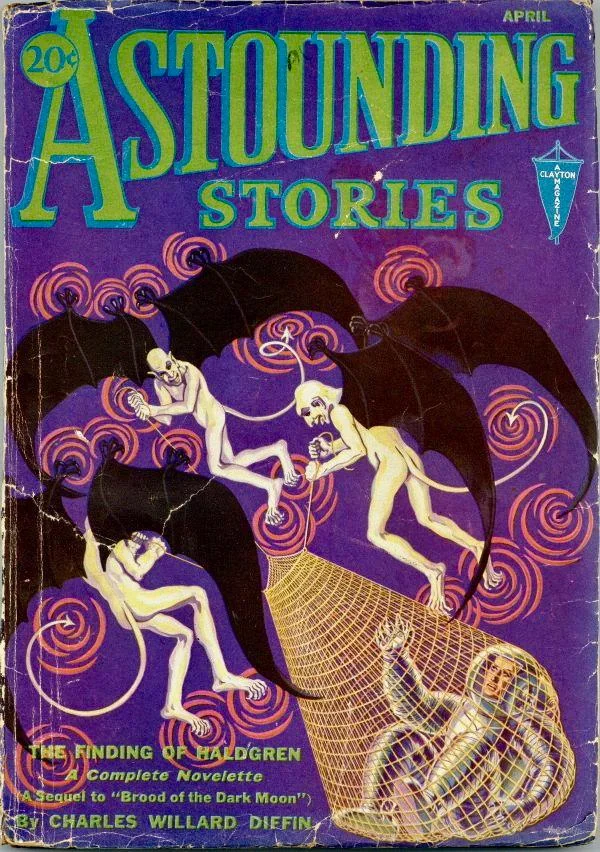
Here's Hans Wessolowski's "playful and art nouveau inspired" cover for Astounding, April 1932:
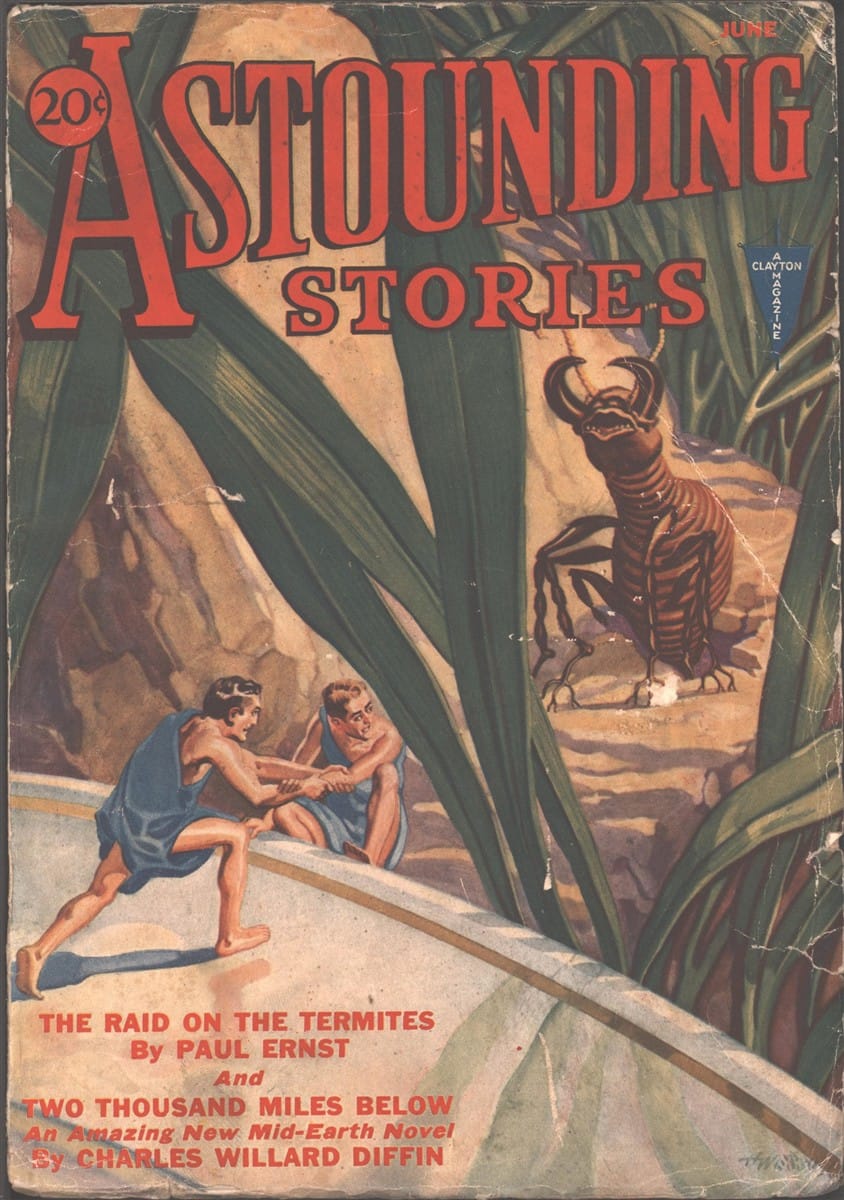
P 74: Here's another Hans Wessolowski cover, June 1932.
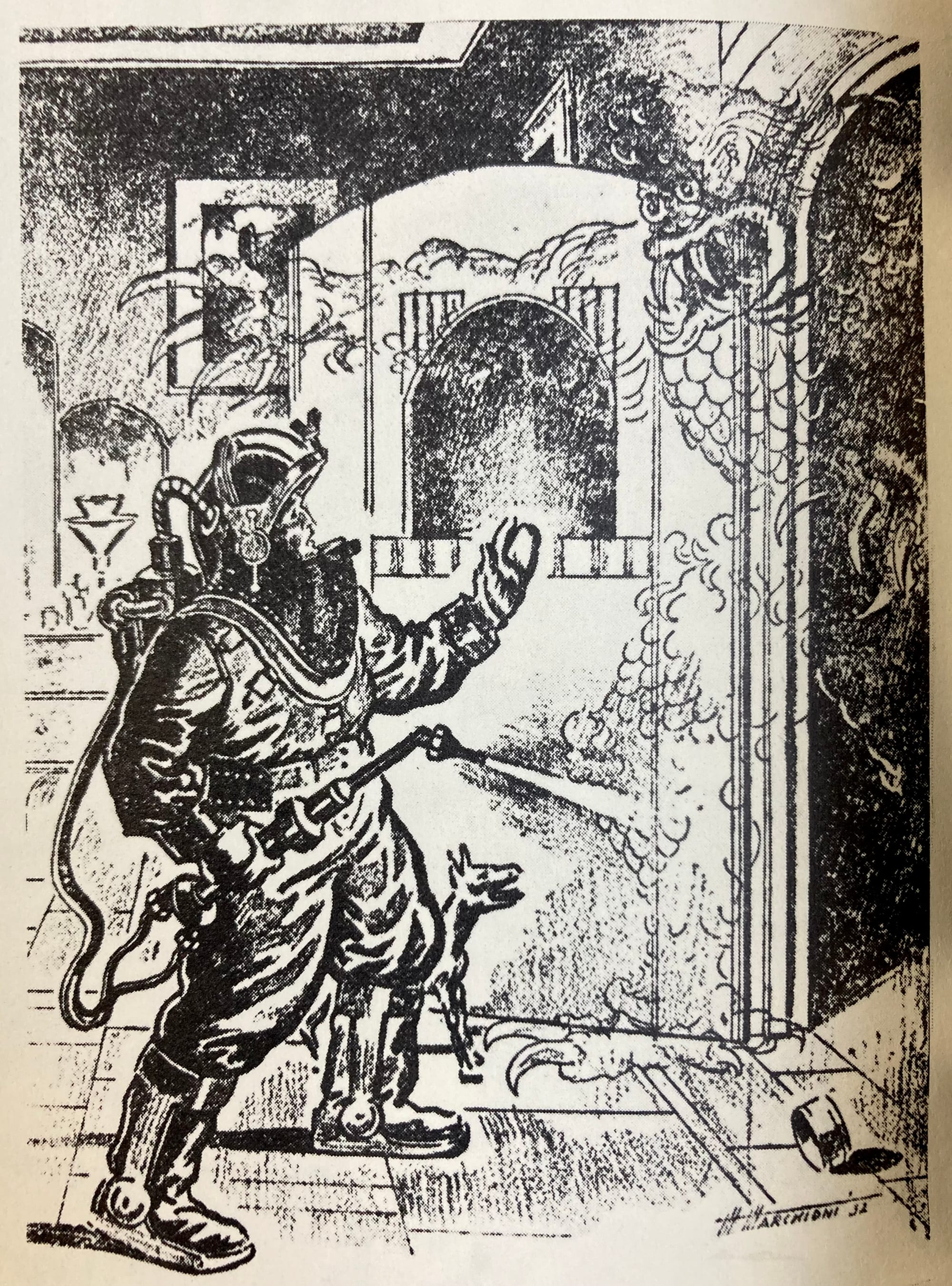
P 76: Mark Marchioni’s interior sketch for Jack Williamson’s ‘Salvage in Space,’ in the March 1933 issue. "The ethereal monster with its outstretched claw contrasts well with the solid astronaut figures."
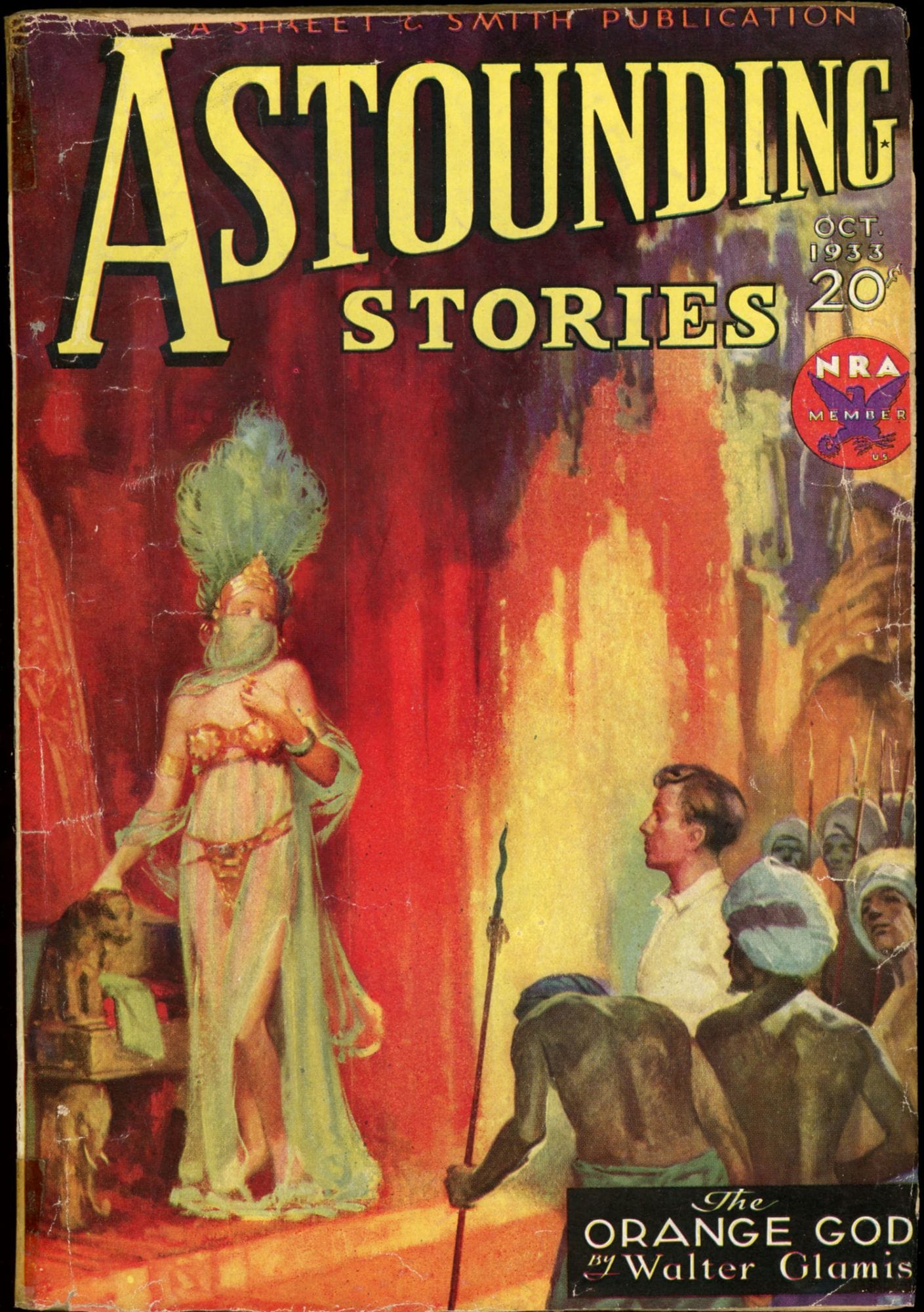
Howard V Brown debuted with the October 1933 cover, which was notably not science fiction. "For a time it appeared as if Astounding had foresaken the genre and plumped for general occult and high adventure stories instead."
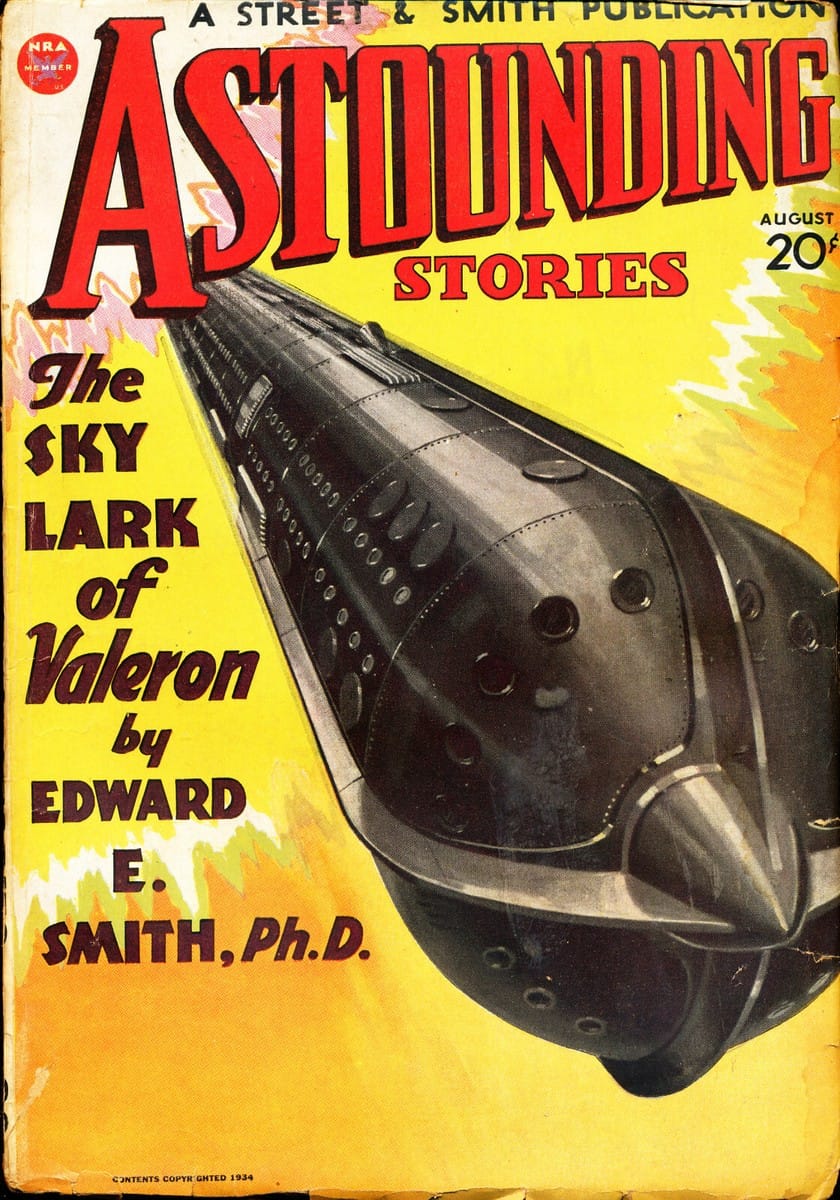
Frewin is impressed with Howard V Brown's August 1934 cover, however, saying: "The detail of the craft is perfect, right down to the rivets strung along the joins of steel sheeting. And should any moon shots have been attempted in the 1930s, this is exactly how the ships would have appeared."
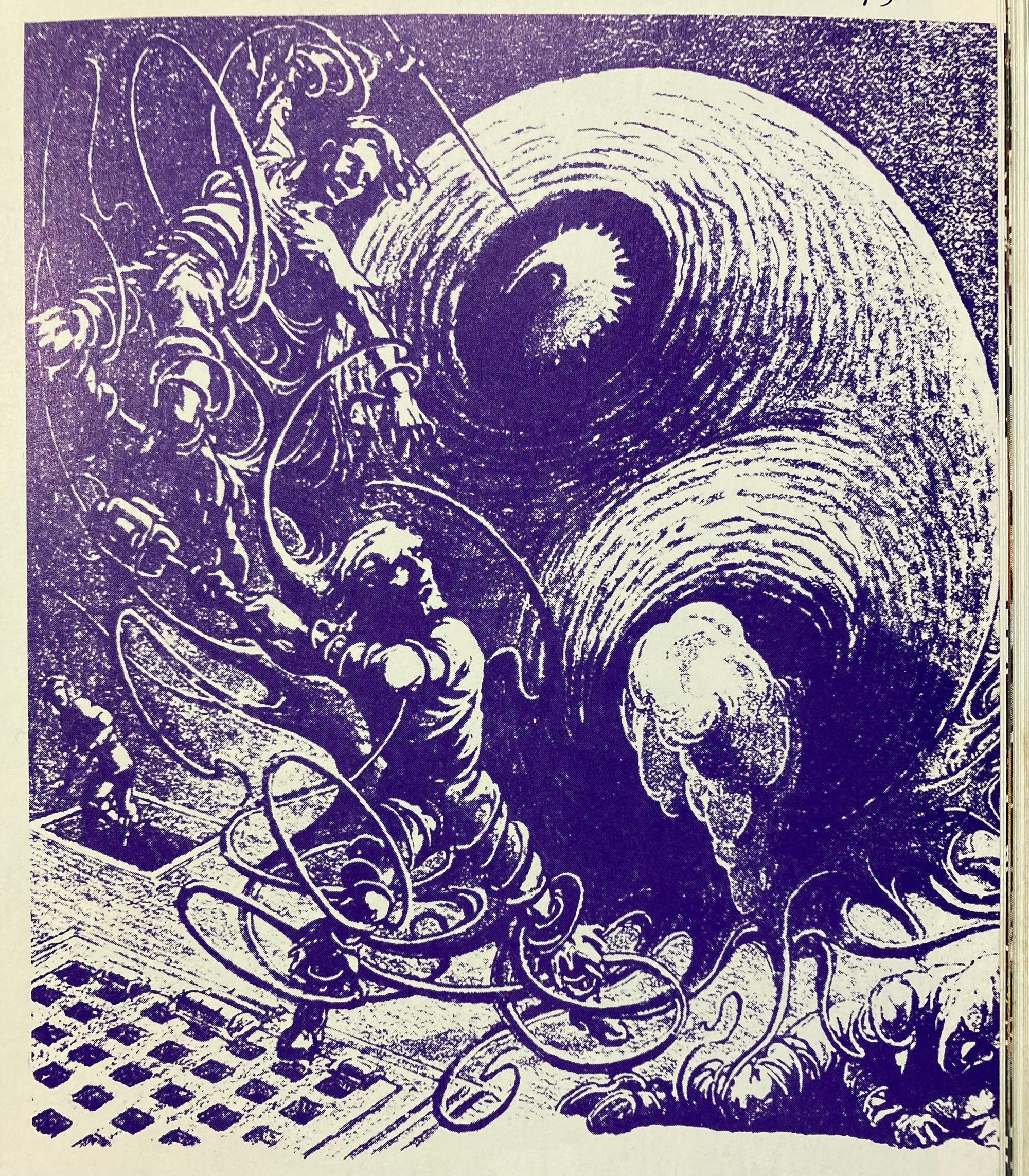
P 79: "Jack Williamson’s ‘The Legion of Space’, August 1934, was graced with this fine example of Elliot Dold’s work. The monstrous rubbery creature with its playing tentacles encircling the hapless humans deserves a place in any cosmic bestiary. Dold’s drawings, while often lacking the wild technological imagination of a Frank R. Paul, were often infused with a drama and urgency that escaped the other illustrators."
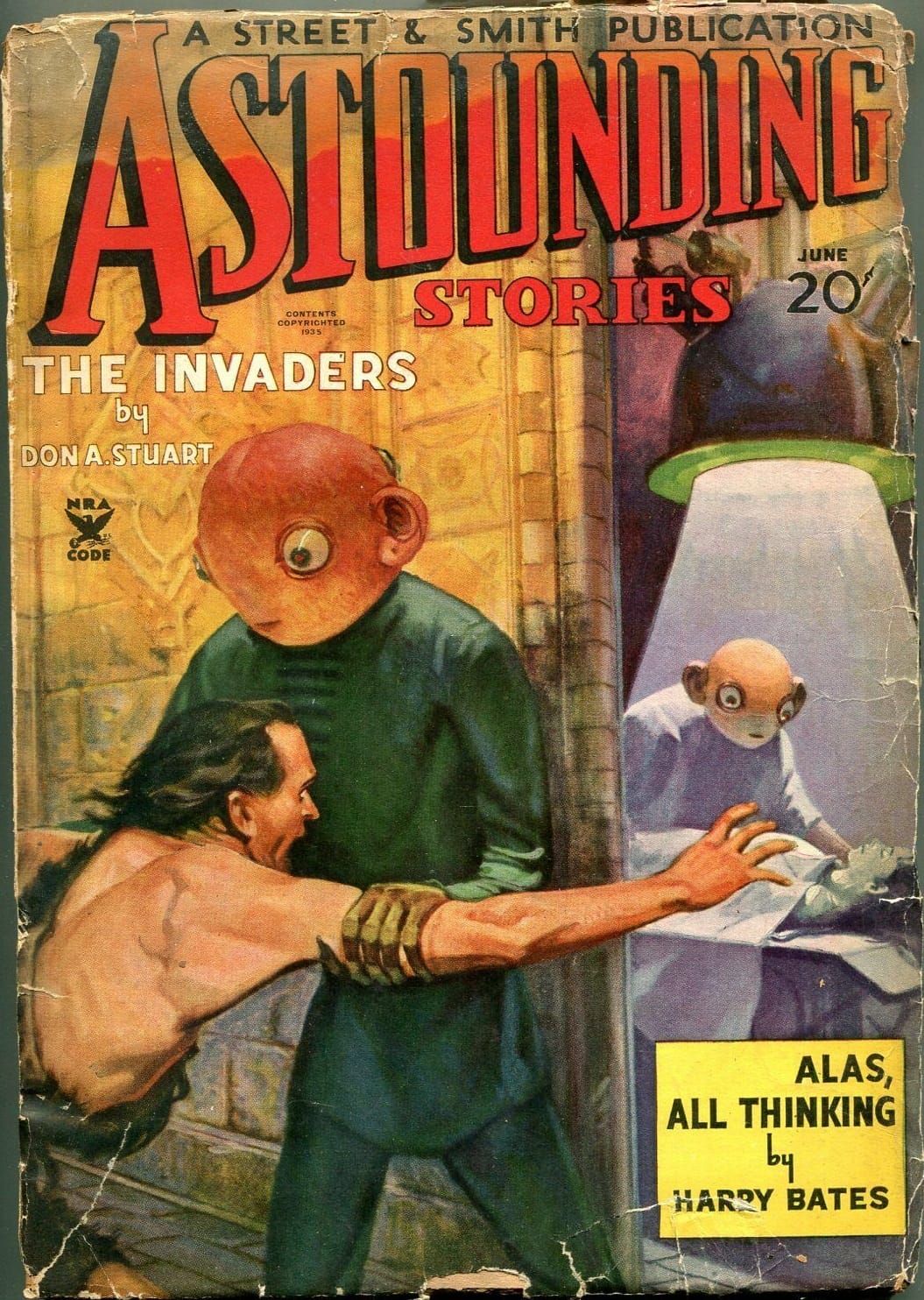
P 80: Okay, here's the first Howard V Brown cover that really blows me away: I love the creepy naturalistic design of these fish-headed aliens! "The photographic-like quality of Brown’s technique further convinces us of the authenticity of the scene," as Frewin puts it. June 1935.
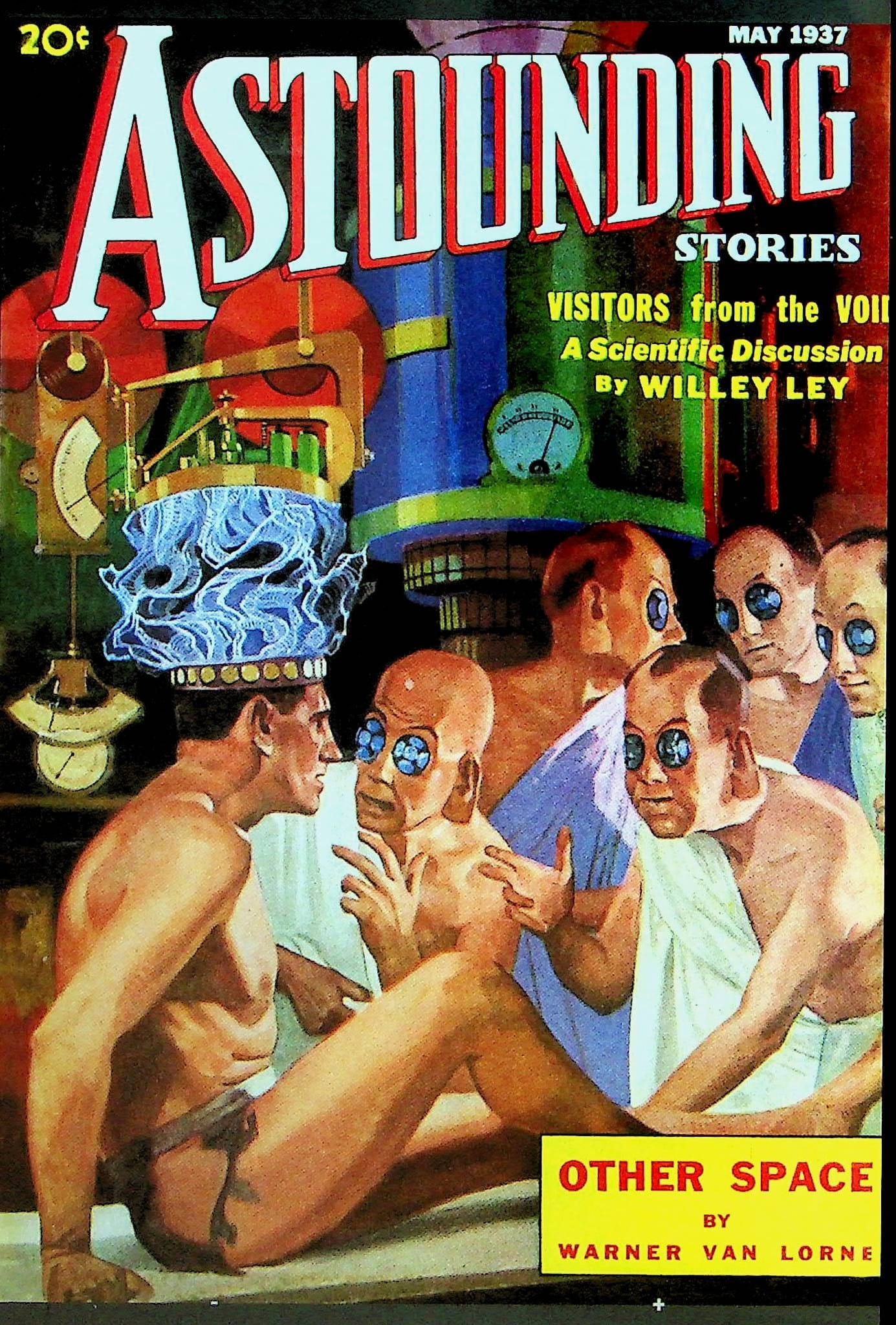
P 83: Another Brown cover, May 1937. Frewin mentions the "photographic-like quality" again for this one.
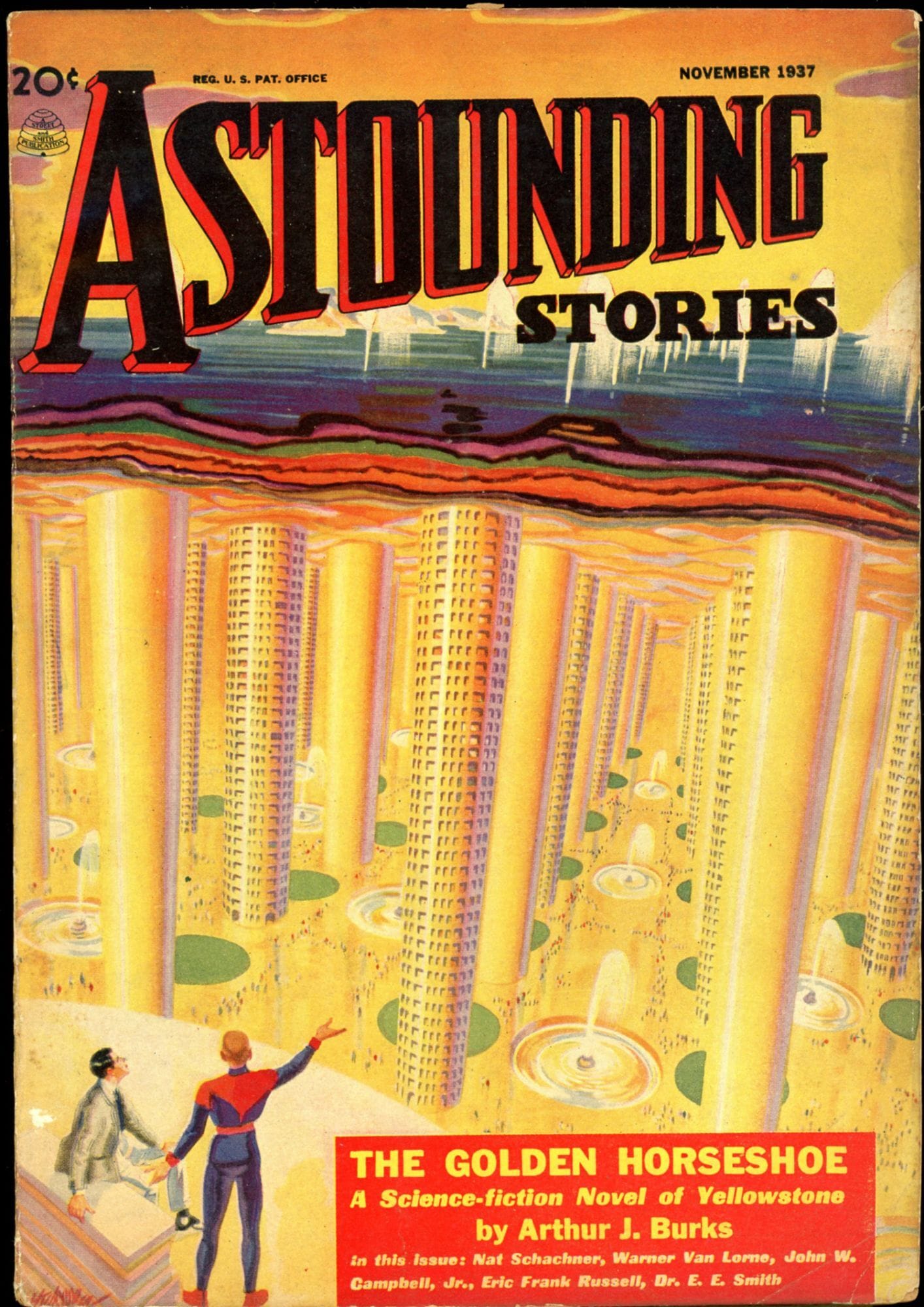
P 86: Wesso returns to Astounding covers in 1937 after apparently taking a break to let Brown run amuck. Here's one of several impressive large-scale scenes he depicted that year: It imagines that Yellowstone's Old Faithful is the result of vast, malfunctioning machinery buried beneath the national park.
P 89: "In September 1937 John W. Campbell was appointed the new editor of Astounding. His editorship would prove to be the most influential in the development of the genre over the next fifty years. One of his first changes was to retitle the magazine. Hitherto it had been Astounding Stories, now it was to be Astounding Science Fiction — Science Fiction and no messing! Alva Rogers notes that Campbell thought the original name ‘lacked dignity, was too pulpishly sensational, and failed to accurately identify the contents between the covers’ (A Requiem for Astounding, Chicago 1964, p.50). His ambition was to phase out the name Astounding altogether so it would eventually be known as Science Fiction. An ambition he would have realised had not a rival pulpeteer issued a new magazine with just such a title."
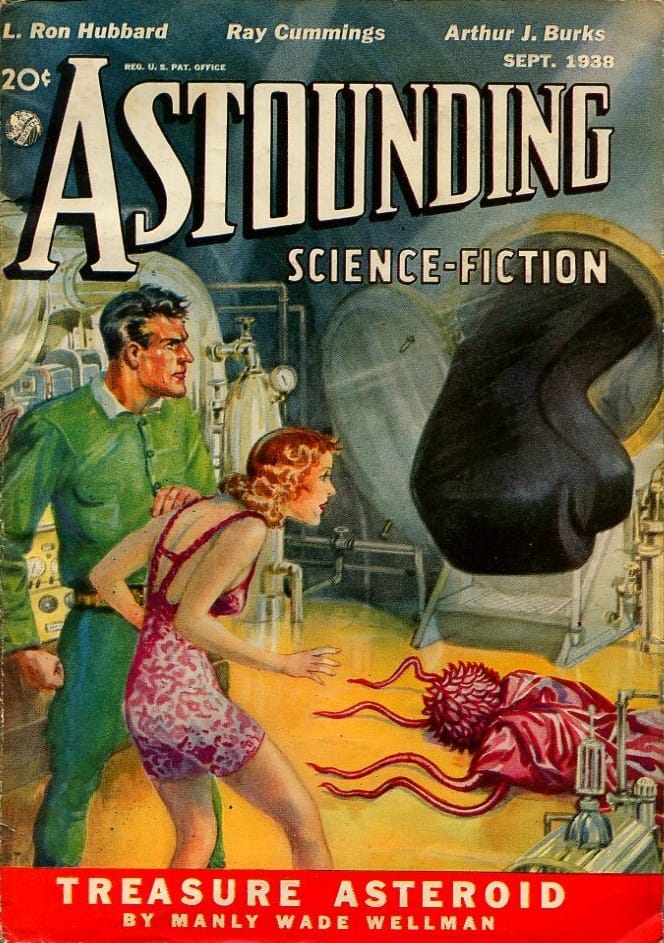
P 89: Here's the rare cover Frewin didn't particularly like, but still included: The Sep 1938 issue, by an artist credited only by the signature "Thomson."
"A dreary affair and very evocative of the 1930s. The man with the clenched fist, knitted brow, and obvious concentration is THINKING, Roland Barthes having just explained to him how the higher cerebration is conveyed in the popular arts. The juxtaposition of the iron fist (without its velvet glove) and the wilted flower figure is a moving contrast."
I had to look up that Roland Barthes joke – he's the philosopher who came up with the "death of the author" literary criticism concept, which would have just been six or seven years before this book was written. Looks like Frewin is gently making fun of him for being too highfalutin, a perspective that I don't think has aged that well in retrospect. Good reminder for me to avoid too many contemporary references in my writing. Anyway, the cover's here:
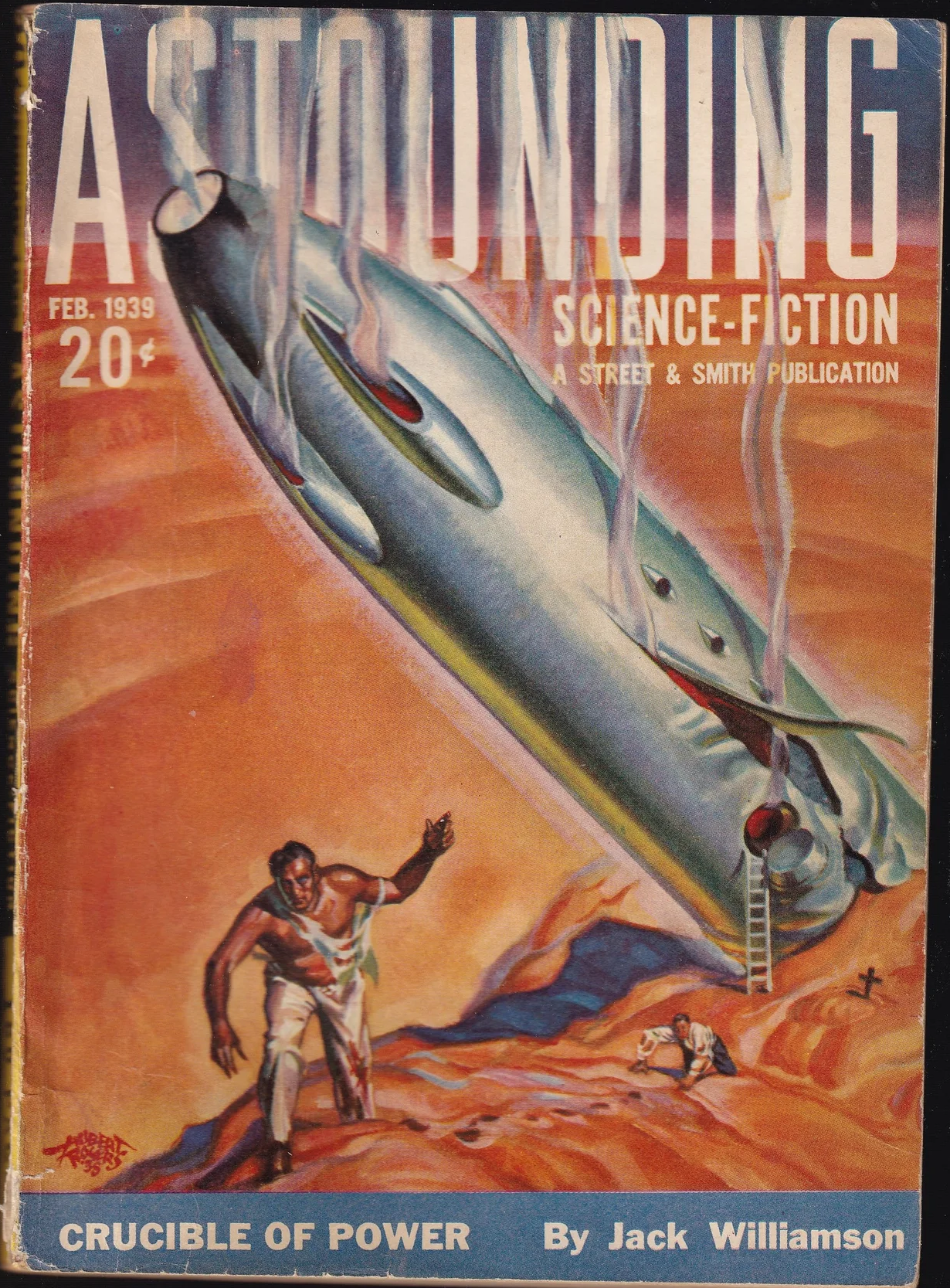
P 91: The Feb 1939 cover has a redesigned title format that allows for a fun crashed spaceship to jut up into the title. The artist is Hubert Rogers, making his "accomplished debut." He "subsequently became the resident colour man for Astounding throughout the 1940s (a period, considered by many, to be the Golden Age of the magazine)."
Okay, that's the end of the notes on this chapter, but I have one more bit of research that I turned up while working on it: This website lists all the most prolific Astounding/Analog cover artists, along with a table that reveals which covers were published in which decade.
Howard V Brown clocks in as the fourth most frequently used artist, with all 53 of his covers done in the '30s, while Wessolowski is the eighth most frequent, with 41.
The third most popular was Hubert Rogers, the guy with that last crashed spaceship cover. He did 44 covers across the '40s, as Frewin indicated.
Number one by a mile was Frank Kelly Freas, with 126 covers and the healthiest three-decade run of any artist, with 30-something covers published per-decade during the '50s, '60s, and '70s. There's a reason I'm always calling that guy prolific!
Number two was John Schoenherr, with 75 covers (51 during his heyday in the 1960s and a healthy 21 in the 70s).
From that website: "Of the leading ASF artists, though, Freas was unusual in that his contribution extended over such a long time. In its early years, one artist would typically do a long run of covers then fall out of favour. Wessolowski, for example, did the first 34 covers straight, i.e., all of those under the Clayton regime. When Street and Smith took over, Wesso was dropped and replaced by Howard V Brown, who then did the next 44 in a row. He then alternated with Wessolowski (who made a brief come-back) and a couple of other artists in 1937-38, then disappeared entirely. ASF experimented for a while before introducing Hubert Rogers in 1939, who then established himself as the new house artist and painted every cover from April 1940 to August 1942. He was in turn supplanted by William Timmins, who was responsible for almost every cover through to the end of 1946.
"After this, the policy of relying on a single artist was dropped and the only one to approach this level of dominance again was John Schoenherr in the 1960s. This was a common practice in the early days of SF&F magazines - compare, for example, Frank Paul at Wonder Stories, Margaret Brundage at Weird Tales or Bergey at Startling Stories."
Cool Link
"I don't think popular culture looks the way it does without John Blanche, Games Workshop's legendary artist who died today. That is mostly for the better, a bit for the worse, but entirely important. I'd go so far as to say that he was the most important commercial artist of the past 50 years, more than Kinkade or Geddes, probably more (and this is a big claim) big film effects studios like Weta Workshop or video game companies like Blizzard."
The lost Parker films - Pulp Curry
I haven't yet gotten into Donald Westlake's Parker series, but I know plenty of people who are - seems like it's the definitive pulp crime novel series. Any Parkerheads reading this might want to check out the two least-heard-of Parker adaptations out there, Mise à Sac (1967) and Slayground (1983).
Music rec: A big collection of Sword and Sorcery music that I liked.
Next Time: Paying readers get the Part 3 for this book on Friday, covering a range of 1930s science fiction art, including some of Frank R Paul's best work.